

11:30 Social Hour
12:00 Opening Keynote
1:30 Collaborative Sessions
2: 45 Networking Session
4:00 Topical Discussion Sessions
5:00 Social Hour
11:30 Social Hour
12:00 Symposia
1:30 Collaborative Sessions
2:45 Collaborative Sessions
4:00 Topical Discussion Sessions
5:00 Social Hour
11:30 Social Hour
12:00 Symposia
1:30 Collaborative Sessions
2:45 Collaborative Sessions
4:00 Topical Discussion Sessions
5:00 Social Hour
11:30 Social Hour
12:00 Symposia
1:30 Collaborative Sessions
2:45 Topical Discussion Sessions
4:00 Closing Plenary
5:00 Social Hour
Times listed in EDT (UTC-4)
Program Highlights:


Times listed in EDT (UTC-4)
Find up to date session details and view in your time zone in Virtual Event Space on AAPS Connect.
Virtual Event Space access shared via email with all registrants.
Tuesday, May 26
11:30 Social hour
12:00 Opening Plenary: Social Impacts of Emerging Technologies
1:30 Concurrent Collaborative Sessions:
- Building a participatory research group in Indigenous Geographies
- Next Generation Global Collaboratory
- Play, civics, and participatory sciences: a (fun) brainstorming workshop
- Professional Pathways in Informal STEM Learning: Tools for your participatory science career
2:45 Plenary: Collaborative Brainstorm: Funding our Future
4:00 Concurrent Topical Discussion Sessions
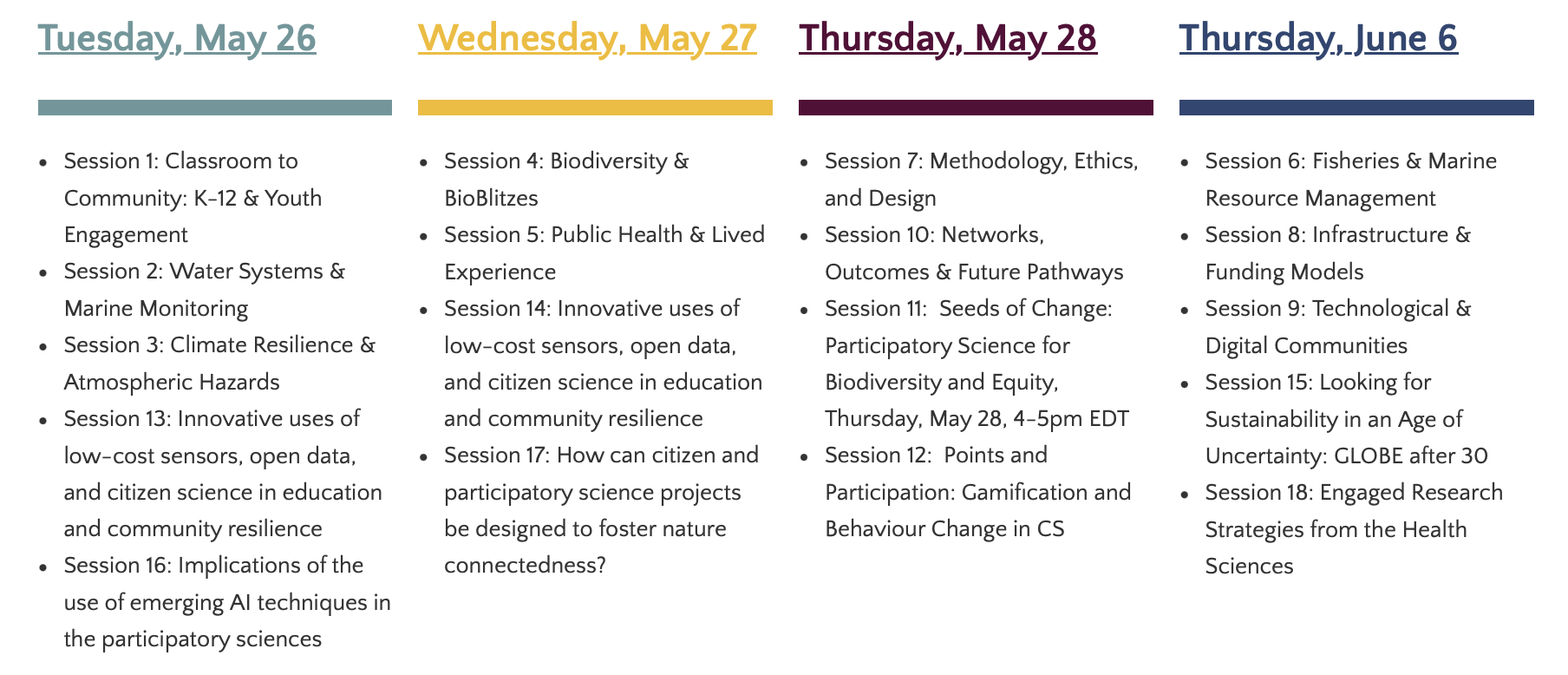
- Session 1: Classroom to Community: K-12 & Youth Engagement
- Session 2: Water Systems & Marine Monitoring
- Session 13: Community-based Environmental Monitoring
- Session 16: Implications of the use of emerging AI techniques in the participatory sciences
5:00 Social hour + Improv Game
11:30 Social hour
12:00 Opening Plenary
Social Impacts of Emerging Technologies
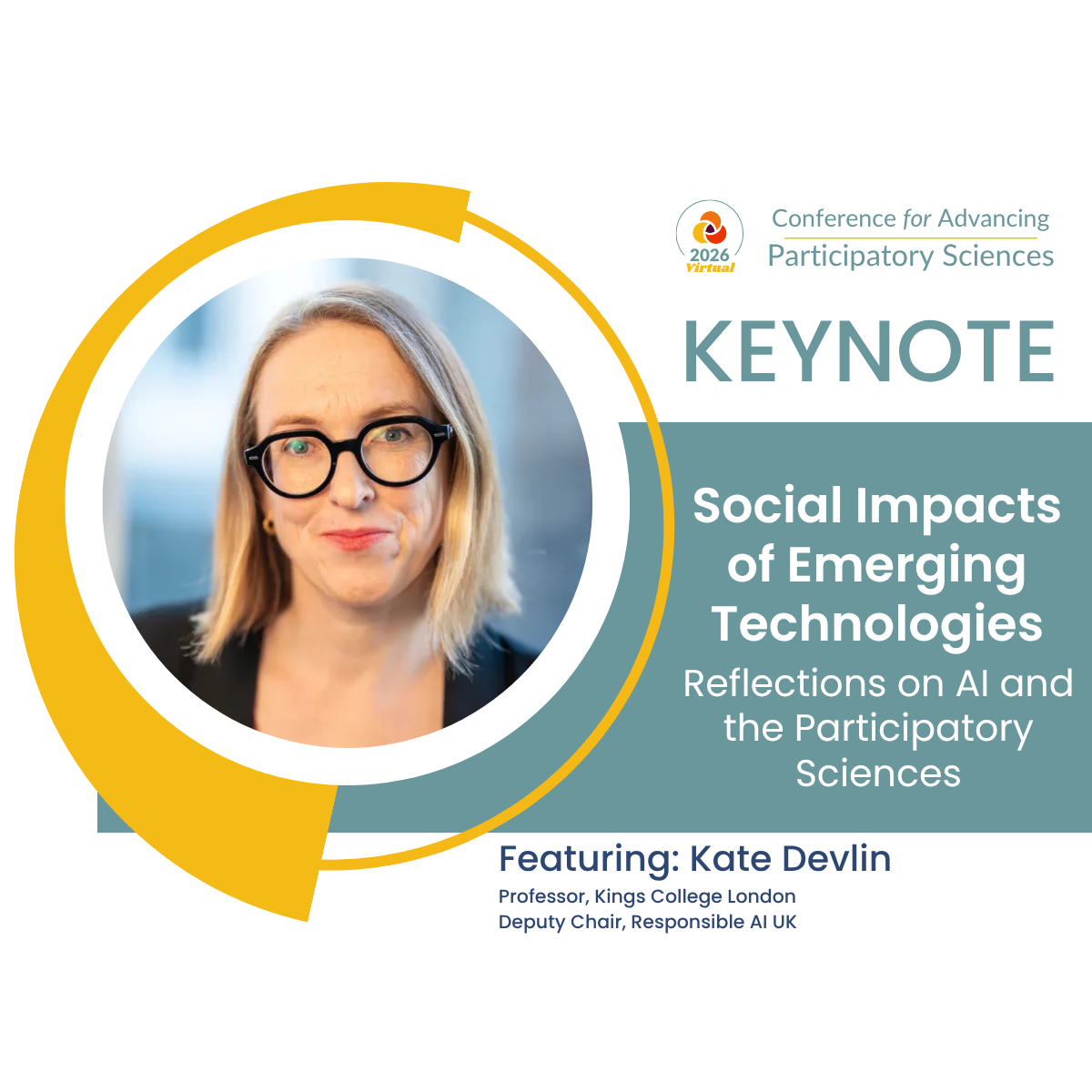
Professor Kate Devlin will offer an opening keynote on the social impacts of emerging technology at CAPS 2026. This plenary session will address the social and ethical implications of AI, and offer insights into how humans relate to emerging technologies.
Presenter: Kate Devlin (full bio) is Professor of AI & Society in the Department of Digital Humanities, King’s College London and is the current Chair-Director of the Digital Futures Institute. Her research investigates how – and why – people interact with and react to technologies, both past and future. Kate is a co-investigator and the King’s College lead on the Repsonsible AI UK programme, which brings together researchers from across the UK to understand how we should shape the development of AI to benefit people, communities and society.
1:30 Concurrent Collaborative Sessions
Building a participatory research group in Indigenous Geographies
This roundtable session will bring together the members of a multidisciplinary, multigenerational research collective that does geographical work with Indigenous communities. This panel will cover the opportunities and challenges of doing this work.
Convener: Niiyokamigaabaw Deondre Smiles (University of British Columbia)
Co-presenters: Weeks, Maya (Rutgers University); Patel, Jugal (McGill University); Routly, Razz (Carleton University), Fuller, Matt (University of Victoria); Pearson, Rhea (KU Leuven); Ack, Amelia (Comox Native Friendship Centre); Lee, Owen (Occidental College); Giancarlo, Alexandra (University of Calgary); Juip, Larissa (Michigan Technological University); Juip, James (Michigan Technological University), Quintero, Melinda (Royal Roads University), Soer, Anna (University of Ottawa)
Next Generation Global Collaboratory
The Next Generation Global Collaboratory aims to broaden its network of participants and funding sources to sustain and grow the next generation of participatory scientists. We leverage advances in affordable sensor technology, enhance access to open data archives through user-friendly data literacy tools, and provide comprehensive analytical training. Together, we are creating a decentralized collaborative community that drives environmental data discovery, understanding and innovation.
Convener: Rebecca Boger (Next Generation Global Collaboratory)
Co-presenters: Rebecca Boger (Next Generation Global Collaboratory); Charles Vorosmarty (Next Generation Global Collaboratory); Russanne Low (Teaching About Planet Earth); Larisa Schelkin (Next Generation Global Collaboratory)
Play, civics, and participatory sciences: a (fun) brainstorming workshop
What does play have to do with science? Come figure it out with us! This session entails a workshop to think about how ideas like creativity, play, joy, belonging, and civic development relate to your participatory science practices. We will provide prompts and time for discussion, and share our own insights and practices. Bring your perspectives, expertise, and curiosity! Session attendees will leave with concrete ideas for infusing elements of play, creativity, and civics in your own work.
Convener: Kirsten Lydic (University of Pennsylvania)
Co-presenters: Prateekshit (Kanu) Pandey (UC Santa Barbara)
Professional Pathways in Informal STEM Learning: Tools for your participatory science career
Professional Pathways is a new suite of tools that can help you identify and develop professional competencies for a career in an Informal STEM Learning (ISL) setting. In this session, participants will reflect on their own professional skills and knowledge by exploring two tools–the Framework and the Self-Assessment. From there, participants will engage in a broader discussion connecting these tools to participatory science. What competencies do participants want to prioritize for their own career development? What competencies does the field need to invest in collectively?
Convener: Jenny Crayne (Association of Science and Technology Centers (ASTC))
Co-presenters: Amanda Fisher (Association of Science and Technology Centers (ASTC))
2:45 Networking Session
4:00 Concurrent Topical Discussion Sessions
- Session 1: Classroom to Community: K-12 & Youth Engagement
- Session 2: Water Systems & Marine Monitoring
- Session 3: Climate Resilience & Atmospheric Hazards
- Session 13: Innovative uses of low-cost sensors, open data, and citizen science in education and community resilience
- Session 16: Implications of the use of emerging AI techniques in the participatory science
5:00 Social hour
Wednesday, May 27
11:30 Social hour
12:00 Plenary: Insights and Innovations from Health Sciences
1:30 Concurrent Collaborative Sessions
- Neurodiversity, inclusivity and wellbeing: Participatory research as a “social prescription”
- Upscaling citizen science creating a tool to address global challenges
- Building Great Teacher Support Materials for Participatory Science
2:45 Concurrent Collaborative Sessions
- Community-Engaged Air Monitoring in Three Environmental Justice Communities
- Supporting youth as community science leaders
- Ways to Publish Your Participatory Science Work
4:00 Concurrent Topical Discussion Sessions
- Session 4: Biodiversity & BioBlitzes
- Session 5: Public Health & Lived Experience
- Session 14: Scaling, tools, education and infrastructure for Citizen Science
- Session 17: How can citizen and participatory science projects be designed to foster nature connectedness?
5:00 Social hour
11:30 Social hour
12:00 Plenary Symposium
AI Meets Community Science: Innovative tools that empower vulnerable communities to improve water quality and resilience
This session explores how community science and artificial intelligence can be combined to track and predict fecal contamination along the Texas coast. Using an environmental forensics approach, partners from The Meadows Center, Clean Coast Texas, and local organizations demonstrate innovative tools that empower vulnerable coastal communities to improve water quality and resilience
Convener: Icen Yoosefdoost (The Meadows Center for Water and the Environment)
Co-presenters: Christina Lopez (The Meadows Center for Water and the Environment, Texas State University); Desiree Jackson (The Meadows Center for Water and the Environment, Texas State University); Nicky, Vermeersch (The Meadows Center for Water and the Environment, Texas State University)
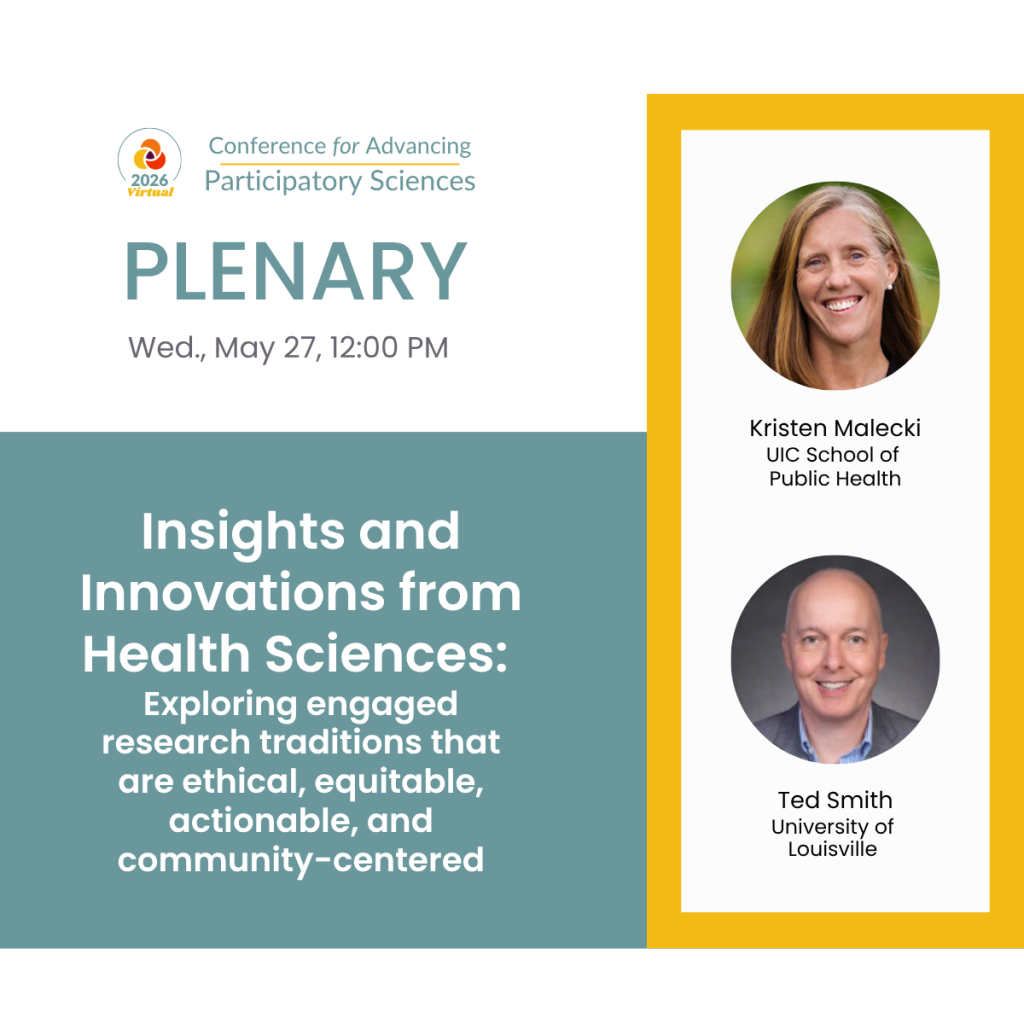
Insights and Innovations from Health Sciences
This symposium will explore how environmental, public, biomedical, and behavioral health sciences can strengthen participatory science through engaged research traditions that are ethical, equitable, actionable, and community-centered. Drawing on their leadership in environmental health, translational research, public health surveillance, wastewater monitoring, climate and health equity, and community-engaged environmental technologies, Drs. Smith, Mehalik and Malecki will share insights from research and practice at the intersection of science, policy, technology, and community partnership. Together, their work highlights how health sciences can advance participatory approaches that respond to complex real-world challenges and support healthier, more equitable communities.
Presenters: Kristen Malecki (University of Chicago School of Public Health); Matt Mehalik (Breathe Project); Ted Smith (University of Louisville)
1:30 Concurrent Collaborative Sessions
Neurodiversity, inclusivity and wellbeing: Participatory research as a “social prescription”
Neurodivergent people – those with mental health and neurological differences such as autism, ADHD, anxiety, PTSD, CFS, low vision, stroke, etc – actively contribute to participatory research. Some report improved social and personal wellbeing as a result, yet others mention accessibility barriers to such participation. We will focus on the potential of participatory sciences to enhance quality of life and will identify practical ways to include neurodivergent people in crowdsourced research.
Convener: Alisa Apreleva (Zooniverse, University of Oxford)
Co-presenters: Rebecca Corona (UC Berkeley)
Upscaling citizen science creating a tool to address global challenges
Through scaling citizen science, we explore the potential of collective actions to address global issues, involving fields such as biodiversity, health, climate adaptation and environmental monitoring. We will discuss topics including funding, data, societal readiness, and support that can be a barrier and enabler of CS scaling.
Convener: James Sprinks (Earthwatch Europe)
Co-presenters: James Sprinks (Earthwatch Europe); Nadia Bates (Museum für Naturkunde Berlin); Rafaella Improta (Universidad Autonoma de Madrid); Dilek Fraisl (IIASA); Gloria Koepke (Universitat Tubingen); Tania Moreira(INOVA+)
Building Great Teacher Support Materials for Participatory Science
How can we best support teachers who wish to do participatory science in their classrooms? Learn how three projects created successful teacher support materials that broke down barriers to bringing participatory science into the K-12 classroom. We’ll also share lessons learned so you can create your own support materials and lead a lively discussion of best practices.
Convener: Chris Goforth (North Carolina Museum of Natural Sciences)
Co-presenters: Chris Goforth (North Carolina Museum of Natural Sciences); Sean Smith (Horizon Research, Inc); Sarah Carrier (North Carolina State University); Lara Gengarelly (University of New Hampshire); Sol Henson (Sierra Streams Institute); Heidi Ballard(Center for Community and Citizen Science, University of California Davis)
2:45 Concurrent Collaborative Session
Community-Engaged Air Monitoring in Three Environmental Justice Communities
This session will focus on three community-driven air quality monitoring partnerships in Prince George’s County (MD), South Ward Newark (NJ), and South Memphis (TN). Using a suite of low-cost sensors (PurpleAir, Modulair, C-12), community scientists collect and use data to understand their environmental riskscape and air pollution exposure realities, and advocate for cleaner air and environmental justice to reduce health risks.
Convener: Vivek Ravichandran (Center for Engagement, Environmental Justice, and Health INpowering Communities (CEEJH INC))
[withdrawn] Facilitating Co-Design through Feedback Loops
This session showcases cyclical mechanisms called feedback loops for cross-sector partnerships to receive, implement, and report on feedback to create a generative knowledge-making system. Feedback loops are tools to disrupt dominant processes for meaning and knowledge making and enact diverse ways of knowing and being. Attendees can expect to gain tangible strategies to enact feedback loops in their unique cross-sector partnerships.
Convener/presenter: Charisse Iglesias (Community-Campus Partnerships for Health)
Supporting youth as community science leaders
In this interactive session, youth, classroom teachers, and session participants will share examples of young people acting as leaders in participatory science projects. In small groups, participants will work to identify the project design elements, strategies, educator resources, and partnerships that contributed to the stories shared. After collective brainstorming, we will generate guidance for community science that cultivates youth agency.
Convener: Meggie Harvey (Gulf of Maine Research Institute)
Co-presenters: Katie Spellman (University of Alaska Fairbanks); Abigail Long (Gulf of Maine Research Institute); ();
Ways to Publish Your Participatory Science Work
A joint informational panel followed by an audience-led discussion on the different ways to publish participatory work. Join editors from the Community Science Exchange and Citizen Science: Theory and Practice to learn about the avenues available and how to turn your work into a paper or resource to publish.
Convener: Allison Schuette (American Geophysical Union)
Co-presenters: TBD
4:00 Concurrent Topical Discussion Sessions
- Session 4: Biodiversity & BioBlitzes
- Session 5: Public Health & Lived Experience
- Session 14: Innovative uses of low-cost sensors, open data, and citizen science in education and community resilience
- Session 17: How can citizen and participatory science projects be designed to foster nature connectedness?
5:00 Social hour
Thursday, May 28
11:30 Social hour
12:00 Concurrent Symposia
- Citizen Science Climate Change Mitigation: Visioning an Interoperable Data Network for Change
- Participatory Science across Scales to Support Communities
1:30 Concurrent Collaborative Sessions
- Brainstorming Citizen Science Climate Change Mitigation: A Community Discussion
- Building from the Ground up: Civic Engagement through Community Science
- What competencies in participatory sciences are in your syllabus?
2:45 Concurrent Collaborative Sessions
- A Replicable Model for Grant Sharing and Collective Impact
- Community Environmental Data x AI Governance
- Using Vertical Collaboration to Build Inclusive Participatory Science from the Ground Up (and Down)
4:00 Concurrent Topical Discussion Sessions
- Session 7: Methodology, Ethics, and Design
- Session 10: Networks, Outcomes & Future Pathways
- Session 11: Seeds of Change: Participatory Science for Biodiversity and Equity
- Session 12: Points and Participation: Gamification and Behaviour Change in CS
5:00 Social hour + 🦇 Bat Trivia
11:30 Social hour
12:00 Concurrent Symposia
Citizen Science Climate Change Mitigation: Visioning an Interoperable Data Network for Change
Imagine a coordinated global network of citizen scientists tracking actions and behaviors that mitigate climate change. Such a network could make climate solutions visible, measurable, and accessible to all. You can be part of shaping this future, building on a recent initiative by the Citizen Science Climate Change Mitigation Working Group, sponsored by the EU’s AURORA project. Join us in turning knowledge into action—one observation, one coordinated dataset, one empowered community at a time.
Convener: Russanne Low (Insitute for Global Environmental Strategies)
Co-presenters: Martin Brocklehurst (Board Chair, Citizen Science Global Partnership (CSGP)); Ram Dayal Vaishnav (Education Director, Citizen Science Asia); Lisa Evans (Co-Chair, Citizen Science Association of New Zealand); Larisa,Schelkin (Global Diplomacy Department, UNITAR)
Participatory Science across Scales to Support Communities
This session will explore how participatory science can be leveraged across geographic scales to support communities. Oftentimes, it is assumed that large scale projects benefit researchers, while only smaller scale projects can truly benefit communities. Our symposium will explore how projects can be designed across scales (local, state wide, and global) to benefit communities’ advocacy goals.
Convener: Dani Lin Hunter (North Carolina Environmental Justice Network)
Co-presenters: Z Strawderman (CleanAIRE NC); Seana Finn (North Carolina State University); Caren Cooper (North Carolina State University); Valerie Ann Johnson (North Carolina Environmental Justice Network)
1:30 Concurrent Collaborative Sessions
Brainstorming Citizen Science Climate Change Mitigation: A Community Discussion
Imagine a coordinated global network of citizen scientists tracking actions and behaviors that mitigate climate change. Such a network could make climate solutions visible, measurable, and accessible to all. You can be part of shaping this future. Bring your expertise, skills, communities, and existing projects/new ideas to the discussion and co-create a participatory science movement stimulated by the Climate Change Mitigation Symposium (Thurs. May 28, 12PM).
Convener: Russanne Low (Institute for Global Environmental Strategies)
Co-presenters: Russanne Low (Institute for Global Environmental Strategies); Martin Brocklehurst (Board Chair, Chair, Citizen Science Global Partnership ); Ram Dayal Vaishnav (Education Director, Citizen Science Asia); Lisa Evans (Co-Chair, Citizen Science Association of New Zealand)
Building from the Ground up: Civic Engagement through Community Science
This session equips participants to identify and address civic priorities collaboratively with community. We’ll share ASTC research on public perceptions of science, then introduce practical tools from our Community Science initiative. Learn how to start with what communities care about and connect science to issues that matter locally.
Convener: Naomi Wallace (Association of Science and Technology Centers)
Co-presenters: Eve Klein (Association of Science and Technology Centers); Naomi Wallace (Association of Science and Technology Centers)
What competencies in participatory sciences are in your syllabus?
The European Citizen Science (ECS) project has developed a competencies framework for citizen science and participatory sciences (CitSciComp) through a consensus-based approach. This session will introduce different competencies identified by the European Citizen Science community and map existing syllabi and training plans to the CitSciComp. This will raise awareness of the CitSciComp and its diverse set of competencies.
Convener: Muki Haklay (Université Paris Cité/Learning Planet Institute )
Co-presenters: Cléa Montanari (Université Paris Cité/Learning Planet Institute ); Andrea Giraldo Sevilla (Learning Planet Institute)
2:45 Concurrent Collaborative Sessions
A Replicable Model for Grant Sharing and Collective Impact
Learn a promising model for funding youth environmental education programs through Youth Learning as Citizen Environmental Scientists (YLACES), a grant-making organization. Using a case study, attendees will explore the power of sharing grant opportunities, how leadership is built among a planning group, the challenges, and the opportunities that result from an intentional collective. Participants will also receive a fillable template to help turn a vision for a youth-focused participatory science program into a YLACES grant-proposal.
Convener: Lee Coykendall (Youth Learning as Citizen Environmental Scientists (YLACES))
Co-presenters: Katherine Hayden (University of Montevallo); Kathyrn Willamson (Kathryn Williamson Consulting); Reggie Holifield (Trio Upward Bound Science and Math Program at the University of Montevallo)
Community Environmental Data x AI Governance
Artificial intelligence presents opportunities and challenges that require a nuanced approach—something more than full scale rejection or adoption. In this listening and learning session, we want to hear your experience and ideate together on best practices and biggest concerns when it comes to data and AI governance, including how to approach developing AI policies and potential risk, what resources are necessary for AI governance, and how we can harness utility while protecting sensitive data.
Convener: Emelia Williams (Open Environmental Data Project)
Co-presenters: Cathy Richards (Open Environmental Data Project); Katie Hoeberling (Open Environmental Data Project)
Using Vertical Collaboration to Build Inclusive Participatory Science from the Ground Up (and Down)
Explore how vertical collaboration within multi-tiered organizations —aligning local leaders, community partners, and institutional staff—can drive more inclusive and impactful participatory science. Using real-world examples including Audubon’s use of the IDEAL program, this interactive session will explore crowd-sourced strategies for building multi-level alignment for equity, regardless of your organization’s size or structure.
Convener: Cooper Farr (National Audubon Society)
Co-presenters: Benjamin Haywood (National Audubon Society); Caren Cooper (North Carolina State University); Anna Woodroof (North Carolina State University)
4:00 Concurrent Topical Discussion Sessions
- Session 7: Methodology, Ethics, and Design
- Session 10: Networks, Outcomes & Future Pathways
- Session 11: Seeds of Change: Participatory Science for Biodiversity and Equity, Thursday, May 28, 4-5pm EDT
- Session 12: Points and Participation: Gamification and Behaviour Change in CS
5:00 Social hour
Friday, May 29
11:30 Social hour
12:00 Concurrent Symposia
- Cultivating Communities of Practice in Participatory Science
- Reflecting on the Participatory Sciences in light of the Trump administration and beyond
1:30 Concurrent Collaborative Sessions
- The elephant in the room: how can participatory sciences help build a stronger democracy?
- Participatory Science Impact Assessment Tool to Measure Program Outcomes
- Science Tank: Pitch Session for Impactful Participatory Science
2:45 Concurrent Topical Discussion Sessions
- Session 6: Making Sense of Data Together
- Session 8: Infrastructure & Funding Models
- Session 9: Technological & Digital Communities
- Session 15: Looking for Sustainability in an Age of Uncertainty: GLOBE after 30
- Session 18: Engaged Research Strategies from the Health Sciences
4:00 Closing Plenary: Funding Participation: Building Sustainable Pathways for Participatory Sciences
5:00 Social hour
11:30 Social hour
12:00 Concurrent Symposia
Cultivating Communities of Practice in Participatory Science
This session explores how communities of practice are bolstering participatory science. Featuring leaders from NASA’s Citizen Science Leader Series, SciStarter’s Ambassador Program, and the USE CitSci undergraduate initiative, panelists will share strategies for building inclusive, sustainable networks that support learning, leadership, and collaboration across diverse contexts.
Convener: Heather Fischer (Oregon State University)
Co-presenters: Sarah Kirn (Gulf of Maine Research Institute); Darlene Cavalier (SciStarter); Heather Vance Chalcraft (East Carolina University); Reanna Putnam (Association for Advancing Participatory Sciences)
Reflecting on the Participatory Sciences in light of the Trump administration and beyond.
As practitioners of the participatory sciences focused on a broad range of issues from Reddit communities to air quality, we’ve seen a societal turn by political elites against the expertise of scientists, of academia, and of journalism, even as the public remains broadly supportive of science. We will share a few relevant examples from our work for context, followed by a conversation with attendees about what our communities can learn from each other about trust and safety in these times.
Convener: Alan Smith (Consumer Reports)
Co-presenters: Sarah Gilbert (Citizens and Technology Lab); Todd Whitney (Independent Reporter-Technologist and Just Tech Fellow with the Social Science Research Council); Brandi Geurkink (the Coalition for Independent Technology Research); , (); (); ()
1:30 Concurrent Collaborative Sessions
The elephant in the room: how can participatory sciences help build a stronger democracy?
This session will frame and hold a reflective discussion on what we – as individuals, as projects, as a field, and as a part of the scientific community – are doing to grow trust in science, create opportunity, and heal societal division, and on how that collective work can be strengthened.
Convener: Sarah Kirn
Co-presenters: Alison Parker; Alan Smith (Consumer Reports)
Participatory Science Impact Assessment Tool to Measure Program Outcomes
The Participatory Science Impact Assessment Tool (PSIAT) is a customizable, web-based instrument that consists of statements about ‘degree of impact’ across a five-point scale. Programs can add, delete, or edit questions to evaluate core impact outcomes that align with the Citizen Science Impact Assessment Framework’s (CSIAF) domains: society, economy, environment, science & technology, and governance to capture participant engagement across behavioral, emotional, and cognitive domains.
Convener: Beth Simmons (Florida International University)
Co-presenters: Yuxi Qiu (Florida International University)
Science Tank: Pitch Session for Impactful Participatory Science
In this interactive session, you can pitch your project idea to a panel of peers. Inspired by “Shark Tank,” this session spotlights innovative ideas and invites real-time feedback, collaboration, and potential support. Attendees will gain insights into what makes a compelling participatory science proposal and how to communicate impact effectively.
Convener: Heather Fischer (Oregon State University)
Co-presenters: Martin Storksdieck (Oregon State University)
2:45 Concurrent Topical Discussion Sessions
- Session 6: Making Sense of Data Together
- Session 8: Infrastructure & Funding Models
- Session 9: Technological & Digital Communities
- Session 15: Looking for Sustainability in an Age of Uncertainty: GLOBE after 30
- Session 18: Engaged Research Strategies from the Health Sciences
4:00 Closing Plenary
Funding Participation: Building Sustainable Pathways for Participatory Sciences
Participatory science delivers public value but is often underfunded by systems built for traditional research. This closing session brings researchers, funders, and policymakers together to examine how participatory science is currently funded, where gaps persist, and what alternative models show promise. Through brief perspectives and interactive dialogue, participants will identify practical strategies to sustain participatory sciences beyond short-term grants.
Convener: Natasha Udu-gama
Presenters: TBA
5:00 Social hour
SESSIONS
Plenary Sessions:


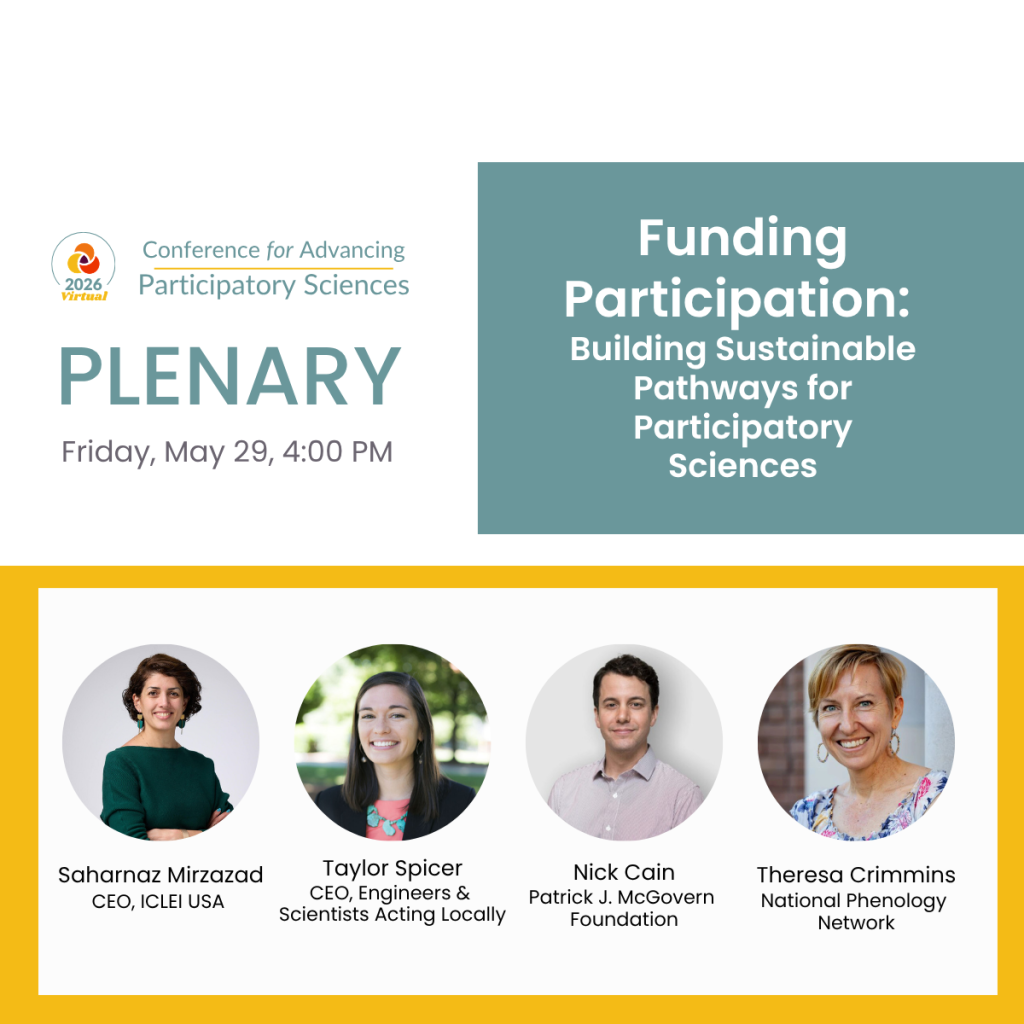
Funding Participation: Building Sustainable Pathways for Participatory Sciences
Closing Plenary [Friday, May 29, 4:00 PM]
Participatory science delivers public value but is often underfunded by systems built for traditional research. This closing session brings researchers, funders, and policymakers together to examine how participatory science is currently funded, where gaps persist, and what alternative models show promise. Through brief perspectives and interactive dialogue, participants will identify practical strategies to sustain participatory sciences beyond short-term grants.
Convener: Natasha Udu-gama
Presenters: TBA
Symposia
AI Meets Community Science: Tracking Fecal Contamination for Coastal Resilience [withdrawn]
[Wednesday, May 27, 12:00 PM]
This session explores how community science and artificial intelligence can be combined to track and predict fecal contamination along the Texas coast. Using an environmental forensics approach, partners from The Meadows Center, Clean Coast Texas, and local organizations demonstrate innovative tools that empower vulnerable coastal communities to improve water quality and resilience
Convener: Icen Yoosefdoost (The Meadows Center for Water and the Environment)
Co-presenters: Icen Yoosefdoost (The Meadows Center for Water and the Environment, Texas State Universit); Christina Lopez (The Meadows Center for Water and the Environment, Texas State University); Desiree Jackson (The Meadows Center for Water and the Environment, Texas State University); Nicky, Vermeersch (The Meadows Center for Water and the Environment, Texas State University)
Citizen Science Climate Change Mitigation: Visioning an Interoperable Data Network for Change
[Thursday, May 28, 12:00 PM]
Imagine a coordinated global network of citizen scientists tracking actions and behaviors that mitigate climate change. Such a network could make climate solutions visible, measurable, and accessible to all. You can be part of shaping this future, building on a recent initiative by the Citizen Science Climate Change Mitigation Working Group, sponsored by the EU’s AURORA project. Join us in turning knowledge into action—one observation, one coordinated dataset, one empowered community at a time.
Convener: Russanne Low (Insitute for Global Environmental Strategies)
Co-presenters: Martin Brocklehurst (Board Chair, Citizen Science Global Partnership (CSGP)); Ram Dayal Vaishnav (Education Director, Citizen Science Asia); Lisa Evans (Co-Chair, Citizen Science Association of New Zealand); Larisa Schelkin (Global Diplomacy Department, UNITAR);
Cultivating Communities of Practice in Participatory Science
[Friday, May 29, 12:00 PM]
This session explores how communities of practice are bolstering participatory science. Featuring leaders from NASA’s Citizen Science Leader Series, SciStarter’s Ambassador Program, and the USE CitSci undergraduate initiative, panelists will share strategies for building inclusive, sustainable networks that support learning, leadership, and collaboration across diverse contexts.
Convener: Heather Fischer (Oregon State University)
Co-presenters: Sarah Kirn (Gulf of Maine Research Institute); Darlene Cavalier (SciStarter); Heather Vance Chalcraft (East Carolina University); Reanna,Putnam (Association for Advancing Participatory Sciences)
Participatory Science across Scales to Support Communities
[Thursday, May 28, 12:00 PM]
This session will explore how participatory science can be leveraged across geographic scales to support communities. Oftentimes, it is assumed that large scale projects benefit researchers, while only smaller scale projects can truly benefit communities. Our symposium will explore how projects can be designed across scales (local, state wide, and global) to benefit communities’ advocacy goals.
Convener: Dani Lin Hunter (North Carolina Environmental Justice Network)
Co-presenters: Z Strawderman (CleanAIRE NC); Seana Finn (North Carolina State University); Caren Cooper (North Carolina State University); Valerie Ann Johnson (North Carolina Environmental Justice Network )
Reflecting on the Participatory Sciences in light of the Trump administration and beyond.
[Friday, May 29, 12:00 PM]
As practitioners of the participatory sciences focused on a broad range of issues from Reddit communities to air quality, we’ve seen a societal turn by political elites against the expertise of scientists, of academia, and of journalism, even as the public remains broadly supportive of science. We will share a few relevant examples from our work for context, followed by a conversation with attendees about what our communities can learn from each other about trust and safety in these times.
Convener: Alan Smith (Consumer Reports)
Co-presenters: Sarah Gilbert (Citizens and Technology Lab); Todd Whitney (Independent Reporter-Technologist and Just Tech Fellow with the Social Science Research Council); Brandi Geurkink (the Coalition for Independent Technology Research)
Collaborative Sessions
A Replicable Model for Grant Sharing and Collective Impact
[Thursday, May 28, 2:45 PM]
Learn a promising model for funding youth environmental education programs. Youth Learning as Citizen Environmental Scientists (YLACES), a grant-making organization, and three recent awardees will share a case study to explore the power of sharing funding opportunities, how leadership is built among a planning group, the challenges, and the opportunities that result from an intentional collective. During this session, participants will work through a template to refine their idea for a youth-focused participatory science program, identify potential partners, and draft a YLACES grant proposal.
Convener: Lee Coykendall (Youth Learning as Citizen Environmental Scientists (YLACES))
Co-presenters: Katherine Hayden (University of Montevallo); Kathyrn Willamson (Kathryn Williamson Consulting); Reggie Holifield (Trio Upward Bound Science and Math Program at the University of Montevallo)
Brainstorming Citizen Science Climate Change Mitigation: A Community Discussion
Imagine a coordinated global network of citizen scientists tracking actions and behaviors that mitigate climate change. Such a network could make climate solutions visible, measurable, and accessible to all. You can be part of shaping this future. Bring your expertise, skills, communities, and existing projects/new ideas to the discussion and co-create a participatory science movement stimulated by the Climate Change Mitigation Symposium (Thurs. May 28, 12PM).
Convener: Russanne Low (Institute for Global Environmental Strategies)
Co-presenters: Russanne Low (Institute for Global Environmental Strategies); Martin Brocklehurst (Board Chair, Chair, Citizen Science Global Partnership); Ram Dayal Vaishnav (Education Director, Citizen Science Asia); Lisa Evans (Co-Chair, Citizen Science Association of New Zealand)
Building from the Ground up: Civic Engagement through Community Science
[Thursday, May 28, 1:30 PM]
This session equips participants to identify and address civic priorities collaboratively with community. We’ll share ASTC research on public perceptions of science, then introduce practical tools from our Community Science initiative. Learn how to start with what communities care about and connect science to issues that matter locally.
Convener: Naomi Wallace (Association of Science and Technology Centers)
Co-presenters: Eve Klein (Association of Science and Technology Centers); Naomi Wallace (Association of Science and Technology Centers)
Building Great Teacher Support Materials for Participatory Science
[Wednesday, May 27, 1:30 PM]
How can we best support teachers who wish to do participatory science in their classrooms? Learn how three projects created successful teacher support materials that broke down barriers to bringing participatory science into the K-12 classroom. We’ll also share lessons learned so you can create your own support materials and lead a lively discussion of best practices.
Convener: Chris Goforth (North Carolina Museum of Natural Sciences)
Co-presenters: Chris Goforth (North Carolina Museum of Natural Sciences); Sean Smith (Horizon Research, Inc); Sarah Carrier (North Carolina State University); Lara Gengarelly (University of New Hampshire); Sol Henson (Sierra Streams Institute); Heidi Ballard (Center for Community and Citizen Science, University of California Davis)
Building a participatory research group in Indigenous Geographies
[Tuesday, May 26, 1:30 PM]
This roundtable session will bring together the members of a multidisciplinary, multigenerational research collective that does geographical work with Indigenous communities. This panel will cover the opportunities and challenges of doing this work.
Convener: Niiyokamigaabaw Deondre Smiles (University of British Columbia)
Co-presenters: Weeks, Maya (Rutgers University); Patel, Jugal (McGill University); Routly, Razz (Carleton University), Fuller, Matt (University of Victoria); Pearson, Rhea (KU Leuven); Ack, Amelia (Comox Native Friendship Centre); Lee, Owen (Occidental College); Giancarlo, Alexandra (University of Calgary); Juip, Larissa (Michigan Technological University); Juip, James (Michigan Technological University), Quintero, Melinda (Royal Roads University), Soer, Anna (University of Ottawa)
Community Environmental Data x AI Governance
[Thursday, May 28, 2:45 PM]
Artificial intelligence presents opportunities and challenges that require a nuanced approach—something more than full scale rejection or adoption. In this listening and learning session, we want to hear your experience and ideate together on best practices and biggest concerns when it comes to data and AI governance, including how to approach developing AI policies and potential risk, what resources are necessary for AI governance, and how we can harness utility while protecting sensitive data.
Convener: Emelia Williams (Open Environmental Data Project)
Co-presenters: Cathy Richards (Open Environmental Data Project); Katie Hoeberling (Open Environmental Data Project)
Community-Engaged Air Monitoring in Three Environmental Justice Communities
[Wednesday, May 27, 2:30 PM]
This session will focus on three community-driven air quality monitoring partnerships in Prince George’s County (MD), South Ward Newark (NJ), and South Memphis (TN). Using a suite of low-cost sensors (PurpleAir, Modulair, C-12), community scientists collect and use data to understand their environmental riskscape and air pollution exposure realities, and advocate for cleaner air and environmental justice to reduce health risks.
Convener: Vivek Ravichandran (Center for Engagement, Environmental Justice, and Health INpowering Communities (CEEJH INC))
Facilitating Co-Design through Feedback Loops [withdrawn]
[Wednesday, May 27, 2:45 PM]
This session showcases cyclical mechanisms called feedback loops for cross-sector partnerships to receive, implement, and report on feedback to create a generative knowledge-making system. Feedback loops are tools to disrupt dominant processes for meaning and knowledge making and enact diverse ways of knowing and being. Attendees can expect to gain tangible strategies to enact feedback loops in their unique cross-sector partnerships.
Convener/presenter: Charisse Iglesias (Community-Campus Partnerships for Health)
Neurodiversity, inclusivity and wellbeing: Participatory research as a “social prescription”
[Wednesday, May 27, 1:30 PM]
Neurodivergent people – those with mental health and neurological differences such as autism, ADHD, anxiety, PTSD, CFS, low vision, stroke, etc – actively contribute to participatory research. Some report improved social and personal wellbeing as a result, yet others mention accessibility barriers to such participation. We will focus on the potential of participatory sciences to enhance quality of life and will identify practical ways to include neurodivergent people in crowdsourced research.
Convener: Alisa Apreleva (Zooniverse, University of Oxford)
Co-presenters: Rebecca Corona (UC Berkeley)
Next Generation Global Collaboratory
[Tuesday, May 26, 1:30 PM]
The Next Generation Global Collaboratory aims to broaden its network of participants and funding sources to sustain and grow the next generation of participatory scientists. We leverage advances in affordable sensor technology, enhance access to open data archives through user-friendly data literacy tools, and provide comprehensive analytical training. Together, we are creating a decentralized collaborative community that drives environmental data discovery, understanding and innovation.
Convener: Rebecca Boger (Next Generation Global Collaboratory)
Co-presenters: Rebecca Boger (Next Generation Global Collaboratory); Charles Vorosmarty (Next Generation Global Collaboratory); Russanne Low (Teaching About Planet Earth); Larisa ,Schelkin (Next Generation Global Collaboratory)
Participatory Science Impact Assessment Tool to Measure Program Outcomes
[Friday, May 29, 1:30 PM]
The Participatory Science Impact Assessment Tool (PSIAT) is a customizable, web-based instrument that consists of statements about ‘degree of impact’ across a five-point scale. Programs can add, delete, or edit questions to evaluate core impact outcomes that align with the Citizen Science Impact Assessment Framework’s (CSIAF) domains: society, economy, environment, science & technology, and governance to capture participant engagement across behavioral, emotional, and cognitive domains. Attendees can provide valuable feedback on the emerging tool and learn more about opportunities to test the tool at their site.
Convener: Beth Simmons (Florida International University)
Co-presenters: Yuxi Qiu (Florida International University)
Play, civics, and participatory sciences: a (fun) brainstorming workshop
[Tuesday, May 26, 1:30 PM]
What does play have to do with science? Come figure it out with us! This session entails a workshop to think about how ideas like creativity, play, joy, belonging, and civic development relate to your participatory science practices. We will provide prompts and time for discussion, and share our own insights and practices. Bring your perspectives, expertise, and curiosity! Session attendees will leave with concrete ideas for infusing elements of play, creativity, and civics in your own work.
Convener: Kirsten Lydic (University of Pennsylvania)
Co-presenters: Prateekshit (Kanu) Pandey (UC Santa Barbara)
Professional Pathways in Informal STEM Learning: Tools for your participatory science career
[Tuesday, May 26, 1:30 PM]
Professional Pathways is a new suite of tools that can help you identify and develop professional competencies for a career in an Informal STEM Learning (ISL) setting. In this session, participants will reflect on their own professional skills and knowledge by exploring two tools–the Framework and the Self-Assessment. From there, participants will engage in a broader discussion connecting these tools to participatory science. What competencies do participants want to prioritize for their own career development? What competencies does the field need to invest in collectively?
Convener: Jenny Crayne (Association of Science and Technology Centers (ASTC))
Co-presenters: Amanda Fisher (Association of Science and Technology Centers (ASTC))
Science Tank: Pitch Session for Impactful Participatory Science
[Friday, May 29, 1:30 PM]
In this interactive session, you can pitch your project idea to a panel of peers. Inspired by “Shark Tank,” this session spotlights innovative ideas and invites real-time feedback, collaboration, and potential support. Attendees will gain insights into what makes a compelling participatory science proposal and how to communicate impact effectively.
Convener: Heather Fischer (Oregon State University)
Co-presenters: Martin Storksdieck (Oregon State University))
Supporting youth as community science leaders
[Wednesday, May 27, 2:45 PM]
In this interactive session, youth, classroom teachers, and session participants will share examples of young people acting as leaders in participatory science projects. In small groups, participants will work to identify the project design elements, strategies, educator resources, and partnerships that contributed to the stories shared. After collective brainstorming, we will generate guidance for community science that cultivates youth agency.
Convener: Meggie Harvey (Gulf of Maine Research Institute)
Co-presenters: Katie Spellman (University of Alaska Fairbanks); Abigail Long (Gulf of Maine Research Institute)
The elephant in the room: how can participatory sciences help build a stronger democracy?
[Friday, May 29, 1:30 PM]
This session will frame and hold a reflective discussion on what we – as individuals, as projects, as a field, and as a part of the scientific community – are doing to grow trust in science, create opportunity, and heal societal division, and on how that collective work can be strengthened.
Convener: Sarah Kirn
Co-presenters: Alison Parker; Alan Smith (Consumer Reports)
Upscaling citizen science creating a tool to address global challenges
[Thursday, May 27, 1:30 PM]
Through scaling citizen science, we explore the potential of collective actions to address global issues, involving fields such as biodiversity, health, climate adaptation and environmental monitoring. We will discuss topics including funding, data, societal readiness, and support that can be a barrier and enabler of CS scaling.
Convener: James Sprinks (Earthwatch Europe)
Co-presenters: James Sprinks (Earthwatch Europe); Nadia Bates (Museum für Naturkunde Berlin); Rafaella Improta (Universidad Autonoma de Madrid); Dilek Fraisl (IIASA); Gloria Koepke (Universitat Tubingen); Tania Moreira(INOVA+)
Using Vertical Collaboration to Build Inclusive Participatory Science from the Ground Up (and Down)
[Thursday, May 28, 2:45 PM]
Explore how vertical collaboration within multi-tiered organizations —aligning local leaders, community partners, and institutional staff—can drive more inclusive and impactful participatory science. Using real-world examples including Audubon’s use of the IDEAL program, this interactive session will explore crowd-sourced strategies for building multi-level alignment for equity, regardless of your organization’s size or structure.
Convener: Cooper Farr (National Audubon Society)
Co-presenters: Benjamin Haywood (National Audubon Society); Caren Cooper (North Carolina State University); Anna Woodroof (North Carolina State University)
Ways to Publish Your Participatory Science Work
[Wednesday, May 27, 2:45 PM]
A joint informational panel followed by an audience-led discussion on the different ways to publish participatory work. Join editors from the Community Science Exchange and Citizen Science: Theory and Practice to learn about the avenues available and how to turn your work into a paper or resource to publish.
Convener: Allison Schuette (American Geophysical Union)
Co-presenters: TBD
Organized Topical Discussion Sessions
The following sessions are accepting submissions through 31 January 2026. >>Submit your idea here.
Environmental Monitoring: How to sustain a project long-term and design for impact
[Tuesday, May 26, 4:00 PM]
There is a long history of environmental monitoring, and it continues to be a practice that is evolving in the face multiple crises. In this session, we highlight 1) how long-term environmental monitoring efforts have sustained or changed through time and 2) how monitoring data has had intended or unintended impacts.
Convener: Rachael Mady (Smithsonian Environmental Research Center)
How can citizen and participatory science projects be designed to foster nature connectedness?
[Wednesday, May 27, 4:00 PM]
A growing body of evidence points to diverse benefits of engaging in environmental citizen/participatory science projects, like increased knowledge, self-efficacy skills, pro-environmental behaviours, to increasing someone’s sense of belonging with the natural world, also known as nature connectedness. How citizen/participatory science experiences foster nature connectedness through project design is yet under-explored. This session invites contributors to explore this theme.
Convener: Cléa Montanari (Université Paris Cité/Learning Planet Institute )
Implications of the use of emerging AI techniques in the participatory sciences
[Tuesday, May 26, 4:00 PM]
AI techniques such as machine learning and computer vision are not new to citizen science, but the recent proliferation of generative AI such as Large Language Models and image generation is rapidly changing the AI ecosystem and public understanding of science. The session will examine the implications for participatory sciences and consider how to ensure that use of AI is not only effective and scientifically robust but also carried out and communicated in a responsible and ethical manner.
Convener: Liz Dowthwaite (University of Nottingham and Responsible AI UK)
Innovative uses of low-cost sensors, open data, and citizen science in education and community resilience
[Wednesday, May 28, 4:00 PM]
Low-cost, small sensor and AI technologies are rapidly evolving and transforming how ground-based environmental monitoring is conducted around the world, providing opportunities for citizen scientists, community-based research, and entrepreneurial initiatives. These technologies raise considerations on how to coordinate instrumentation specifications, data collection methods, open data integration and archiving, among other topics. This session welcomes contributions on these and related topics.
Convener: Rebecca Boger (Next Generation Global Collaboratory)
Looking for Sustainability in an Age of Uncertainty: GLOBE after 30
[Friday, May 29, 2:30 PM]
Funding uncertainties for participatory science have impacted long-supported programs such as Global Learning and Observations to Benefit the Environment (GLOBE). We share a vision for a more flexible structure, including virtual training, flexible electronic data sheets, and simplified account structure and support systems. This topical discussion session will examine how GLOBE leaders and participants are navigating funding uncertainties and will inform projects facing similar disruptions.
Conveners: Christina Buffington (University of Alaska Fairbanks and GLOBE Implementation Office); Jacqueline DeLisi (EDC, GLOBE Implementation Office), Holli Kohl (NASA Goddard/ GLOBE Observer); and Russanne Low (Institute for Global Environmental Strategies/GLOBE Implementation Office)
Points and Participation: Gamification and Behaviour Change in CS
[Thursday, May 28, 4:00 PM]
The application of gamification or game-like elements in citizen science is widely used to improve engagement and also has the potential to lead to further behavioural impact. This interactive session brings together citizen science practitioners, researchers, and CS community members to share lessons from real projects using game elements to motivate engagement, learning, and sustained impact. Together, we’ll explore successes, pitfalls, and practical takeaways for future initiatives.
Conveners: Nimisha Parashar (University of Nottingham); Liz Dowthwaite (University of Nottingham)
Seeds of Change: Participatory Science for Biodiversity and Equity
[Thursday, May 28, 4:00 PM]
This session explores participatory science innovations as “transformative seeds” linking biodiversity, nature-based solutions, equity, and behavioural change. This session will create space for projects and initiatives from diverse global contexts, while also building on insights from Horizon Europe projects including DAISY, PLANET4B, and NATALIE – which examine biodiversity prioritisation and transformative change. Together, we will showcase and reflect on how co-created interventions can foster values shifts, enhance response-ability, and support just and lasting transformations across scales.
Conveners: Agnes Zolyomi (Green Formation); Alex Franklin (Coventry University); Claire Narraway (Earthwatch Europe)
Individual Presentations
This is the heading
Lorem ipsum dolor sit amet, consectetur adipiscing elit. Ut elit tellus, luctus nec ullamcorper mattis, pulvinar dapibus leo.
Featuering Kat
Featuering Kat