Looking to build a sustainable source of funding for your project? Let these sessions inspire and activate you:
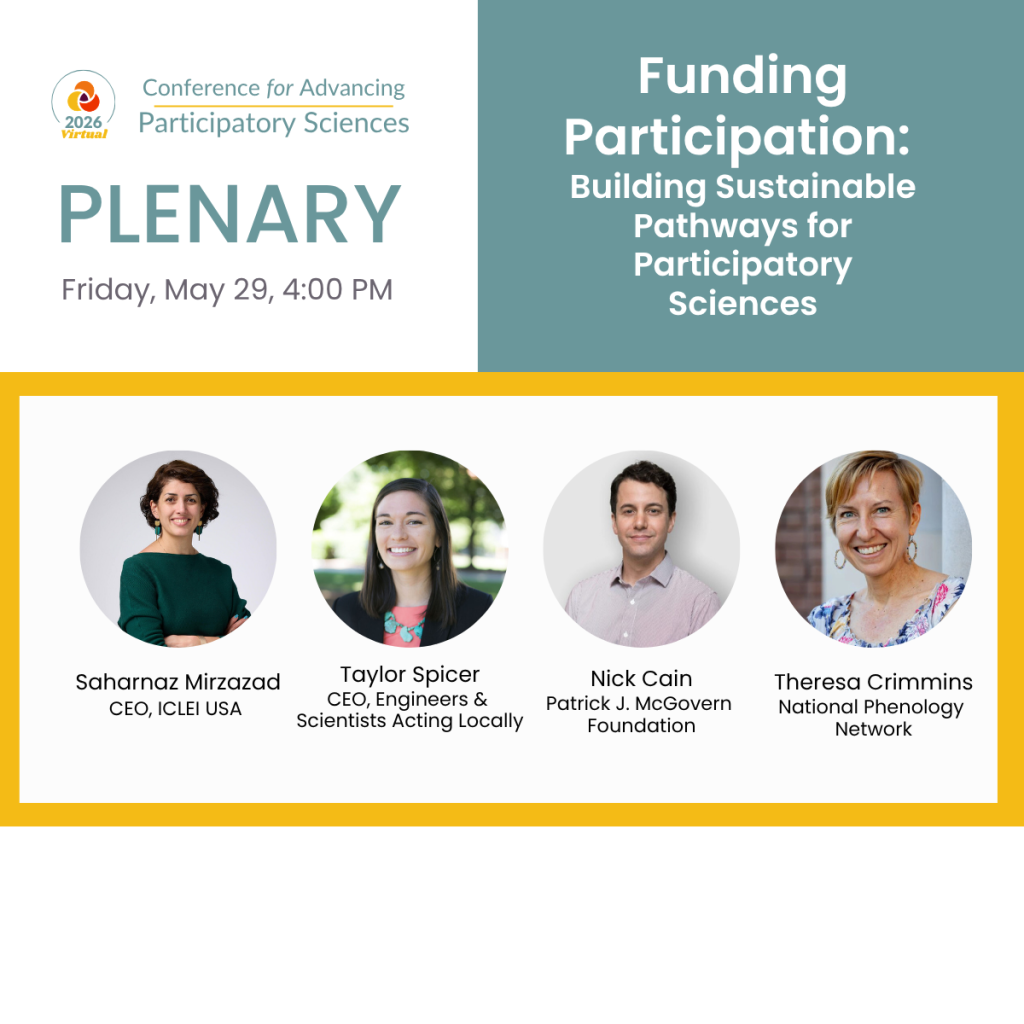
Funding Participation: Building Sustainable Pathways for Participatory Sciences
Closing Plenary [Friday, May 29, 4:00 PM]
Participatory science delivers public value but is often underfunded by systems built for traditional research. This closing symposium session is designed to help researchers, funders, and policymakers examine how participatory science is funded now, where the biggest structural barriers persist, and what more sustainable pathways could look like in practice. Through brief perspectives and guided Q and A, participants will identify practical strategies to sustain participatory sciences beyond short-term grants.
Speaker remarks will be informed by community input shared in Tuesday’s Collaborative Brainstorm: Funding our future session via by comments below. Please use the comment section to share your thoughts on this topic.
Convener: Natasha Udu-gama
Presenters: Saharnaz Mirzazad (ICLEI USE); Taylor Spicer (Engineers & Scientists Acting Locally (ESAL)); Nick Cain (Patrick J. McGovern Foundation); and Theresa Crimmins (National Phenology Network, University of Arizona)
Collaborative Brainstorm: Funding our future
Plenary Collaborative [Tuesday, May 26, 2:45 PM]
An interactive hour exploring how we fund participatory projects. The core of the session features curated small-group discussions on the future of our field. We’ll use a new tool called Matchboard to pair you with peers for balanced, high-impact dialogue. Guided by targeted prompts, these connections will directly inform Friday’s session: Funding Participation: Building Sustainable Pathways for Participatory Sciences. Come build community and influence the field’s future.
Convener: CAPS Program Committee with support from Clean Conferencing Institute
A Replicable Model for Grant Sharing and Collective Impact
Collaborative Session [Thursday, May 28, 2:45 PM]
Learn a promising model for funding youth environmental education programs. Youth Learning as Citizen Environmental Scientists (YLACES), a grant-making organization, and three recent awardees will share a case study to explore the power of sharing funding opportunities, how leadership is built among a planning group, the challenges, and the opportunities that result from an intentional collective. During this session, participants will work through a template to refine their idea for a youth-focused participatory science program, identify potential partners, and draft a YLACES grant proposal.
Convener: Lee Coykendall (Youth Learning as Citizen Environmental Scientists (YLACES))
Co-presenters: Katherine Hayden (University of Montevallo); Kathyrn Willamson (Kathryn Williamson Consulting); Reggie Holifield (Trio Upward Bound Science and Math Program at the University of Montevallo)
Science Tank: Pitch Session for Impactful Participatory Science
Collaborative Session [Friday, May 29, 1:30 PM]
In this interactive session, you can pitch your project idea to a panel of peers. Inspired by “Shark Tank,” this session spotlights innovative ideas and invites real-time feedback, collaboration, and potential support. Attendees will gain insights into what makes a compelling participatory science proposal and how to communicate impact effectively.
Convener: Heather Fischer (Oregon State University)
Co-presenter: Martin Storksdieck (Oregon State University)
Looking for Sustainability in an Age of Uncertainty: GLOBE after 30
Organized Topical Discussion Session [Friday, May 29, 2:45 PM]
Funding uncertainties for participatory science have impacted long-supported programs such as Global Learning and Observations to Benefit the Environment (GLOBE). We share a vision for a more flexible structure, including virtual training, flexible electronic data sheets, and simplified account structure and support systems. This topical discussion session will examine how GLOBE leaders and participants are navigating funding uncertainties and will inform projects facing similar disruptions.
Conveners: Christina Buffington (University of Alaska Fairbanks and GLOBE Implementation Office); Jacqueline DeLisi (EDC, GLOBE Implementation Office), Holli Kohl (NASA Goddard/ GLOBE Observer); and Russanne Low (Institute for Global Environmental Strategies/GLOBE Implementation Office)
>>View presentations in this session here
Registration for CAPS 2026 is open! >>Find full event details here.