

– Call for Late Breaking Posters Now Open –
Share your insights, research, experience or new ideas about practices for participatory sciences: the tools, strategies, or innovations that make for successful projects.
It’s easy to submit, and presenting can open doors for more ideas, connections, and inspired work in this field.
AAPS is calling for submissions covering many approaches to research by, for, and with members of the public for the 2025 Conference for Advancing Participatory Sciences (CAPS 2025), happening May 27th – 30th in Portland, Oregon.
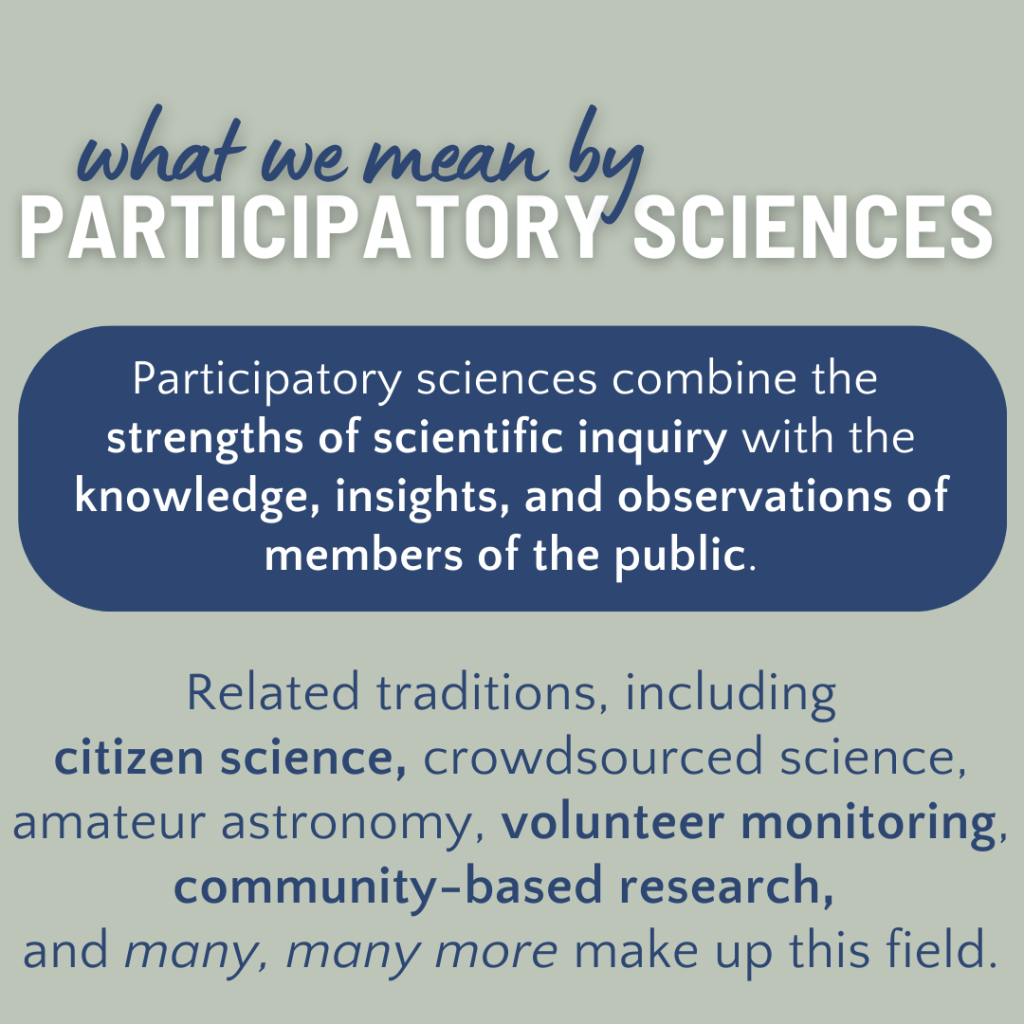
We invite submissions that share stories and insights into the work behind participatory sciences (including community science, citizen science, crowdsourcing, volunteer monitoring and more), and share the important scientific contributions that can result from these practices.
Presentations provide an avenue for sharing your original ideas and finding connections with others in this field. CAPS 2025 is accepting submissions for two types of presentations: a Poster, or a Talk as part of a Discussion Session.
- What gets presented at this meeting? Ideas and insights that highlight what has been done or could be done to make participatory science projects successful and the field impactful. This call is for Talks and Posters (symposia and workshops have already been selected).
- Who can submit? Anyone working to make participatory sciences powerful and possible. This event uniquely brings together all of the people and perspectives needed for projects to thrive. That includes academics from all disciplines, community leaders, data managers, tech designers, librarians, and all who are part of project teams.
- Is this event for me? See above! And, just to start, here are a few reasons students/early career professionals, community leaders and researchers (just to start) can find value from being part of CAPS conversations.
- Do I have to have research findings? Only if that’s the type of knowledge you want to share. Other options include sharing stories of lessons learned and ideas for emerging work.
- Great! How do I propose an idea? We have a simple submission form linked below, as well as a planning guide to help you prepare.
Individual Presentation Types:

Talks are a chance to share your work with an audience and then engage with the audience and other presenters in a discussion. Talks will be part of 75-minute sessions with up to 7 presentations on a common theme. Presenters will share their work for 8 minutes, followed by 2 minutes of questions. Then there will be a 20-25 minute discussion at the end for the audience and presenters to discuss their work collectively.

Posters provide a touchstone to start a one-on-one conversation – to share ideas, invite and ask questions, and learn more together by talking with others in this community about our work. Presenters will share their work in a large-scale visual, print format in the conference poster gallery at one of two afternoon poster sessions.
Themes (overview):
Click on each topic for highlights, or on the embedded links for more expanded details on each theme.
Technology-driven innovation
Diversity and inclusion
Ethical considerations
Policy and decision-making
Knowledge collaborations
Participatory science methods
Education and learning
Scientific contributions to knowledge and discovery
Submission Basics:
– The call for individual presentations closed on 15 January 2025 –
If you would like to share your work with the participatory sciences community as part of our 2025 conference, please complete the submission form, available here.
This form works best when you have all of your materials ready. Please review this planning guide ahead of time to help you prepare.
Late breaking poster submissions will be accepted through April 30th. Submissions will be accepted in English only and must be submitted through the online submission form. Proposals submitted after the deadline will not be considered. All who submit will also be invited to take part in the peer review process.
After submission, proposals will be reviewed on a rolling basis by the program committee and authors will be notified of decisions within three weeks of submission, no later than May 14th.
We welcome submissions from any of the following perspectives:
- RESEARCH FINDINGS: findings from research, sharing insights into participatory science practices.
- STORY OF LESSONS LEARNED: lessons learned from on-the-ground experiences
- EMERGING WORK: inviting feedback on new projects, technologies, or research in progress (may be descriptive, but not promotional).
Looking for more details?
How to prepare your idea:
Ideas that are a good “fit” for this event are:
- Relevant to work in the field of participatory sciences (citizen science, community science, volunteer monitoring, crowdsourced science, etc.)
- Focused on practices/what works (such as building relationships, designing for action, integrating equity principles)
- Have informative stories, research outcomes, lessons learned, or emerging work to share with others in this field.
Here’s what you need to prepare:
- Title (100 characters or less)
- Author list (names, emails, and who is presenting)
- Short summary (250 characters or less, aka 1-2 sentences)
- Detailed overview/abstract that expands on the short summary (2000 characters or less)
- Everything else is just answers to some basic menu-based questions like your presentation type (Talk or Poster), themes, and so on (the full set of options are in the PLANNING GUIDE).
Timeline and terms:
Who can submit? Anyone! If your project or work falls under the participatory sciences umbrella, we welcome your ideas and perspective at this conference. We want to bring together people from all spheres, spaces, and disciplines: volunteers, students, data managers, community leaders, librarians, scientists, teachers, to just name a handful!
How many ideas can I submit? Only one submission per presenting author will be considered. You can be listed as a co-author on multiple submissions, but you can only be the presenting author for one submission.
Will this cost me anything? There is no cost to submit a talk or poster. If accepted, the presenting author will need to register for and travel to attend the 2025 conference in person (see rates and options here).
What is the deadline again? Late-breaking poster submissions will be accepted on a rolling basis through April 30th.
When will I hear back? Proposals will be reviewed and authors will be notified of decisions within three weeks of submitting, no later than May 14th.
Who reviews these ideas? The CAPS 2025 Presentation Committee, a sub-committee of the Conference Planning Committee, will facilitate the anonymous review of all submissions. Each submission will have 2-4 volunteer reviewers.
If I am accepted, then what? All presenters must register to attend the conference by March 15, 2025 to confirm their participation and be included in the program.
Review Criteria:
Proposals will be assisted using the following criteria:
- Highlight research findings, stories of lessons learned, or emerging work relevant to the participatory sciences
- Illuminate and contribute to one of the conference themes (see Themes below)
- Provide clear methods or processes for the insights shared (e.g., based on decades of experience, user testing, evaluation data, etc.)
- Focuses on practices that advance a big topic, idea, or challenges within the participatory sciences
This event strives to provide relevant, quality content that advances our field. All proposals will be reviewed and ranked by the CAPS 2025 conference committee who will make final decisions regarding acceptance following peer-review. Peer review is an important part of that process, and as such all who submit will be invited to opt into the anonymous review process. Reviewers will use criteria designed to ensure that submitted content is relevant to the Conference and meets the Association’s values of diversity, respect and collaboration, accessibility, participation, integrity, and transparency. See event code of conduct for additional detail
Themes:
The following themes were identified by the CAPS 2025 Presentation Committee and will be used to help group presentations into sessions focusing on themes relevant to practitioners from across disciplines, roles, and approaches to this work. The examples under each theme below are meant to give you an idea of what types of conversations could be relevant under each theme. Use the down arrows to expand to view examples of each theme.
Technology-driven innovation:
- AI and Machine Learning: Projects that use technologies and volunteer support to analyze vast amounts of data more efficiently, leading to new discoveries and insights.
- Mobile Apps and Platforms: Projects that involve user-friendly apps making it easier for people to participate in participatory science projects.
- IoT Devices: Internet-connected devices (IoT) enabling real-time data collection and monitoring for a range of environmental and other scientific variables.
Diversity and inclusion
- Bridging the Gap: Efforts ensuring that projects are accessible to people from diverse backgrounds, including those with disabilities and from marginalized communities.
- Community-Based and Boundary Organization Partnerships:Leveraging partnerships to bring project opportunities to new audiences.
Ethical considerations
- Data Privacy and Security: As the volume and complexity of data in the participatory sciences increases, ensuring its privacy and security becomes a paramount concern.
- Responsibilities to Participants: Processes that support fairness and equity by attending to priorities of all partners and ensuring that everyone benefits from participatory science projects.
Participatory science for policy and decision-making
- Influencing Policy: The ways that participatory science data and research results are being used to inform policy decisions on a range of issues, from climate change to public health.
- Community-led Research: Expanding access to tools, labs, and data for communities to advocate for change and to take action on pressing issues.
- Coalition Building: Partnerships between scientists, policymakers, and community organizations that enable communities to advocate for change and take action on priority issues.
Knowledge collaborations
- Beyond Traditional Boundaries: Participatory science projects that cross disciplinary boundaries, leading to more holistic and innovative research.
- Braiding Indigenous Knowledge and Western Science: Projects that build and reflect different knowledge traditions for deeper understandings and respectful planning.
Participatory science methods
- Data Management and Use: Designing protocols for data collection, classification and analysis that lead to successful project and participant outcomes.
- Data visualization and sharing project outcomes: Examples of innovative approaches to sharing project outcomes with stakeholders.
- Volunteer Training and Outreach: How has (or has not) the landscape of online learning changed strategies for effective volunteer engagement?
Education and Learning
- Evaluation: How do we know what participants are learning and what strategies are effective for programs designed to educate the general public?
- Colleges and Careers: Higher education institutions are integrating participatory sciences into curricula to connect class themes to real science, as well as providing valuable professional learning to advance careers in the participatory sciences.
- Engaging Younger Learners: Tools, strategies, and outcomes of involving students in authentic scientific research, whether in formal or informal settings.
Scientific contributions to knowledge and discovery:
- Addressing Global Challenges: Developing sustainable technologies, understanding climate patterns, and proposing mitigation strategies; improving disease diagnosis, treatment, and prevention; or exploring alternative energy sources, efficient resource management, and sustainable agriculture.
- Expanding Basic Discoveries: Contributing to fundamental scientific advancement, in fields like health, physics, chemistry, biology, ecology, etc., or developing technological advancements that support scientific discovery.
We recognize that this list of examples is not comprehensive, and that your work might fit into more than one category. When submitting, presenters will be given the opportunity to identify up to three themes, in order of preference, that apply to their work. There will also be an “Other” option for you to input your own theme in the submission form.