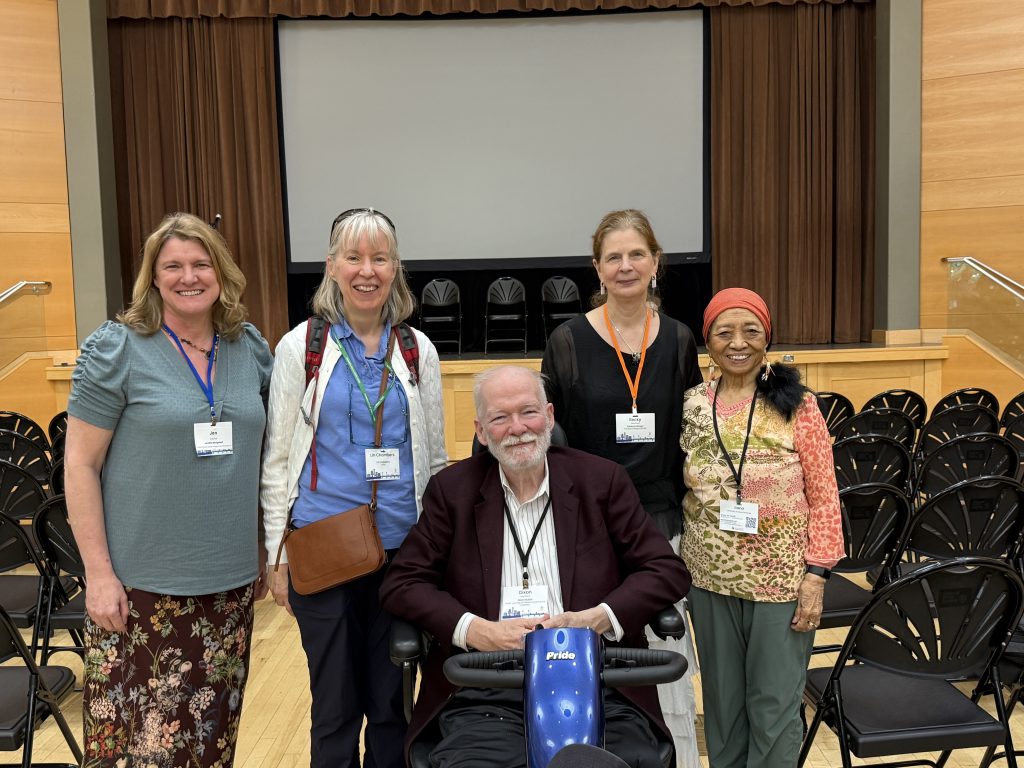
For his vision in growing and sustaining the GLOBE Program, his ongoing work to champion and support the use of science by youth and youth educators, and his role as a mentor and wise counsel for many in the emerging field of participatory sciences, AAPS is pleased to recognize Dr. Dixon Butler with the first ever AAPS award for Lifetime Contributions to the Participatory Sciences.
This honor was presented as part of the 2025 Conference for Advancing Participatory Sciences. This new award is being established to recognize those who have, across their careers, created an atmosphere for impacts and innovations in the participatory sciences. The award aims to celebrate an individual’s generous and extensive commitments to colleagues, projects, research, and the field throughout their lifetime, and those whose work serves as an inspiration to others.
Dr. Butler’s expansive career (see bio) includes serving as Chief Scientist and as Director of NASA’s GLOBE Program, bringing together his expertise in atmospheric sciences, his passion for STEM education, and his experience developing NASA’s Earth Observing System. In retirement he founded, and serves as President of, the Youth Learning as Citizen Environmental Scientists (YLACES) not-for-profit. Dixon was a founding member of AAPS (then Citizen Science Association) and has generously shared his experience to guide the growth of this emerging community.
During a conference reception that also celebrated the 20th anniversary of the GLOBE program, Dr. Lin Chambers and Dr. Becky Boger–two long-standing leaders and colleagues from the GLOBE program–reflected on Dixon’s significant impacts on the field.
“No mention of Dixon would be complete without mentioning some of the people he mentored who have gone on to successful careers which continue to intersect participatory science,” Lin Chambers remarked, “I will mention just a few, but my list is by no means complete:
- Dr. Elena Sparrow at University of Alaska – Fairbanks – one of the first (and maybe longest active) GLOBE Partners, who herself now serves as a mentor to another long list of successful scientists, educators, and students.
- Dr. Becky Boger, previously a NOAA Knauss Fellow, then a GLOBE Desk Officer, and now the Director of the GLOBE STEPE team.
- John McLaughlin, another NOAA Knauss Fellow who has played a major role in the NOAA Office of Education for years, and also helped lead an interagency Federal Citizen Science Community of Practice over the last decade.”
A short video, made as part of the GLOBE Program’s 30th Anniversary celebration, recognizes the many contributions of Dixon to the program.
Please join AAPS in congratulating, and celebrating the accomplishments of, Dr. Dixon Butler.
Biography:
Dixon Butler, Founder and President of YLACES, is a consultant on a wide range of science-related areas. His deep expertise includes science, information system management, satellite mission planning, STEM and environmental education, budget and appropriations, remote sensing, energy, environment, nuclear, and space policy.
Following a public school education in Richmond, Virginia, he attended Harvard (AB ’71, AM, ’71) and Rice Universities (MS, ’74; PhD, ’75). His research focus was atmospheric photochemical modeling first of planetary ionospheres and subsequently of stratospheric ozone depletion. At NASA, he had an early transition from research to serving as a science program manager. He received the 1979-80 American Physical Society Congressional Science Fellowship. Afterwards he returned to NASA Headquarters where he managed stratospheric and solar-terrestrial research, led the planning of the Earth Observing System (EOS), and went on to lead a division with responsibility for all NASA Earth science mission operations and data systems including the development of EOS Data and Information System.
In 1996, he joined the leadership team of the GLOBE Program. Dixon served as GLOBE’s third Chief Scientist and eventually as Deputy Director and Director. In 2003, Butler joined the Democratic staff of the House Committee on Appropriations, serving as minority clerk of the Energy and Water Subcommittee until 2006 and then as majority clerk in 2007. He then worked on the Commerce, Justice, Science subcommittee with responsibility for the appropriations accounts of NASA and NSF. He retired from federal service in January 2011 and began consulting with a primary focus on NASA and its continuing operation of GLOBE.
Dr. Butler is married with four grown children and four grandchildren. He is President of the Virginia Environmental Endowment and chairs its Board of Directors. He is supportive of his wife’s many activities in the theater and arts communities of Washington, DC.
Background:
The GLOBE (Global Learning and Observations to Benefit the Environment) Program is a science and education program that focuses on advancing Earth systems science through data collection and analysis by citizen scientists. The GLOBE Program’s primary goal is to advance Earth system science and its applications.
Since the start of the GLOBE program in 1995, more than a quarter billion data measurements have been submitted to GLOBE’s database by more than 1.2 million citizen scientists of all ages from more than 125 countries. To date, tens of thousands of educators have been trained in GLOBE’s protocols and supported more than 900,000 students who have engaged with GLOBE data collection.
YLACES assists and rewards the implementation of inquiry-based, experiential science education where students do science and contribute to the understanding of our environment through recognition and financial reward programs.
YLACES makes grants of equipment, materials, and supplies that enable student participation in taking environmental measurements and contributing their data to citizen science programs. Grants are also available for systemic initiatives, development of educational materials, and creative ideas that support students doing research and learning to think scientifically.