
The CAPS Program Committee invites submissions for organized sessions (symposia, workshops, or collaborative sessions) that advance a proposed topic of importance in the field. Proposing an organized session is your opportunity to shape discussion around issues you care about, build collaborations, and showcase your leadership in the field.
See below for evaluation criteria and details on how to submit. Curious if an organized session is right for you? Start here:

What gets presented at this meeting? Ideas and insights that highlight what has been done or could be done to make participatory science projects successful and the field impactful.
Who can submit? Anyone working to make participatory sciences powerful and possible. This event uniquely brings together all of the people and perspectives needed for projects to thrive. That includes academics from all disciplines, community leaders, data managers, tech designers, librarians, and all who are part of project teams.
What do you mean by organized sessions? Session types include symposia, workshops, and collaborative sessions (see table below). Organized sessions form the core of the program and are a high profile way to shape the event.
Is this event for me? See above! And, just to start, here are a few reasons students/early career professionals, community leaders and researchers (just to start) can find value from being part of CAPS.
Is this the only way to present? This call is for organized sessions only. The call for individual presentations will be released later this fall. Convening an organized session is an opportunity to curate experiences for groups of people at the conference. If you are primarily looking to share your own research findings, emerging work, or lessons learned, an individual presentation may be a better fit.
Great! How do I propose an idea? We have a simple submission form linked below, as well as a planning guide to help you prepare. The deadline for proposal submissions is Tuesday 20 October 2026, at 11:59 PM EST EXTENDED: Tuesday 3 November, 2027 at 11:59PM ET.
Organized Session Types:
The following table provides an overview of different session types and presentation opportunities. In general, organized sessions are for people who want to shape a conversation or experience for a group of participants. Individual presentations are for people who primarily want to share their own research, emerging work, or lessons learned. Please note that the call for talks and posters will not open until after the call for organized sessions closes.
| Best for: | Format: | Space in Program: | |
| Organized Session Types: Submissions due 20 October 2026 | |||
| Symposium | Deep, field-building discussions on a topic of broad relevance | Panel discussion with speakers with diverse perspectives i.e. subject matter experts from different fields and who wouldn’t normally cross paths | 75-minute concurrent session as part of the core conference program. |
| Workshop | Hands-on, interactive, experiential, engagement-focused sessions with stated learning objectives | Longer format offerings that demonstrate and teach tools, techniques, and/or methods | 2-, 4-, or 6-hours sessions to take place on Monday before or Friday after the conference. Workshop fees will be charged to ensure participation and cover needed expenses. |
| Collaborative Session | Community collaboration, collective problem solving, or generative discussions | Engaged sessions with opportunities for audience participation. Examples include: gallery walks; fishbowls; listening session; roundtable | 75-minute concurrent sessions as part of the core conference program. |
NEW THIS YEAR:
We are piloting opportunities for session leaders to gain added visibility through support from a sponsoring organization. You can OPT IN to be considered for enhanced attention both pre- and post-conference via attendee notices, social media, and session reflections. Consider this an opportunity to be introduced to a new champion of your ideas, without commitment (you can decline any suggested sponsor match). Even better, you can SUGGEST SPONSORS you would be proud to have introduce your session (1min at the top) and elevate your work. Both are entirely optional; responses to these two questions are not shared with session reviewers and have no bearing on consideration for the program.
PLANNING YOUR ORGANIZED SESSION PROPOSAL
We encourage you to explore collaborations with others you know working on the topic as spaces in the schedule are limited and not all submissions will be accepted. Should multiple proposals be submitted on similar topics, you may be asked to consider a combined session or a different session type.
Evaluation Criteria for all proposals:
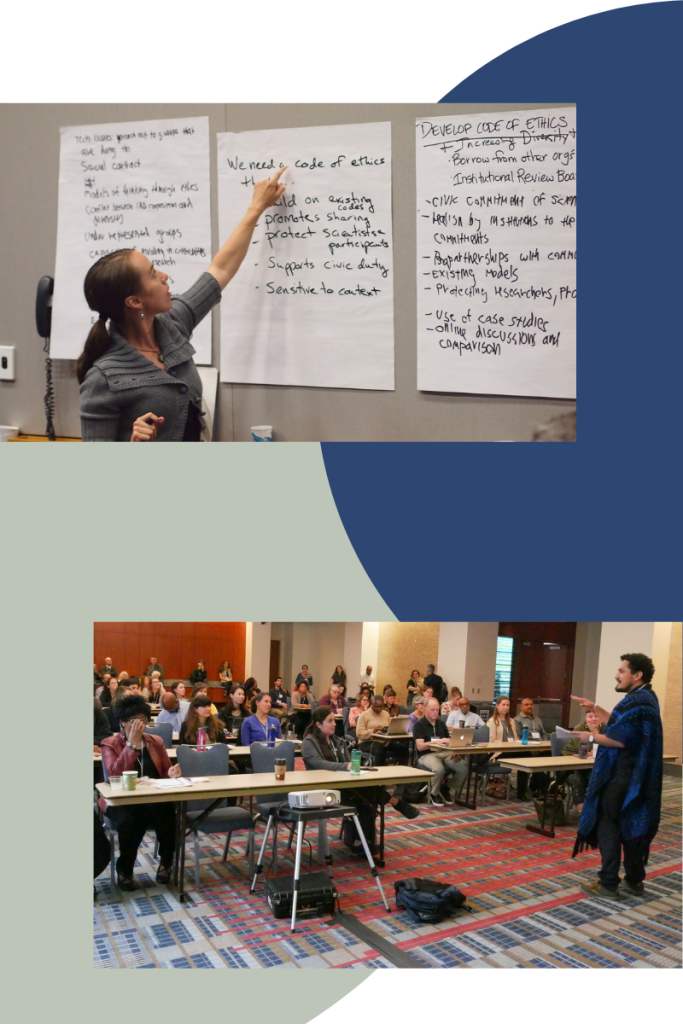
All organized session proposals will be reviewed and ranked by the AAPS Conference program committee. Proposals will be assessed to the degree to which they:
- Focuses on a topic, idea, or challenge within the participatory sciences
- Advances understanding of theories or practices that strengthen work in this field
- Provide clear grounds for the insights shared (e.g., based on experience, user testing, evaluation data, etc.)
- Offer a clear objective for the session (what people will take away, how your session will make a difference)
- Propose a topic and format well suited for the session type
- Appeal to a broad audience from different disciplines, roles, and experience levels
Criteria/Requirements for Specific Session Types:
Symposia:
- Include contributors and ideas from multiple backgrounds and perspectives
- Think about this as an opportunity for a conversation across people and perspectives who may otherwise never be heard together – and why/how that can be powerful. This could look like:
- Community leaders, students, and academics
- Non-profit organizations, agencies, and philanthropists
- Subject matter experts from different fields and who wouldn’t normally cross paths
- Think about this as an opportunity for a conversation across people and perspectives who may otherwise never be heard together – and why/how that can be powerful. This could look like:
- All organizers and presenters in your session are required to register for the event and attend in-person – we cannot not support pre-recorded contributions. Registration rates are on a sliding scale, with discounts and waivers available- see registration rates here.
Workshops:
- Clearly outlined what skills or knowledge participants will gain as a result of taking part in the session
- Specific learning objectives are well defined. Avoid vague terms like “understand” or “learn.” Instead, use more specific terms like “apply/create/evaluate/demonstrate/identify”
To keep costs low for the majority of attendees, registration fees do not cover any of the hard costs for activities that take place on Monday or Friday (room rentals, food, etc.). AAPS works hard to make workshops and field trips accessible to all attendees while not burdening those who opt out with the added costs. We will work with you to identify costs, fees, strategies to ensure accessibility, and opportunities for external support. reserves the right to charge a fee for participation in professional development opportunities (with attention to supported access where fees are prohibitive). Workshop organizers can choose to cover a portion of participant fees.
Paying a fee is an indication of value, and can:
- Ensure participation vs. no-shows – this helps leaders know who to expect, and makes sure that limited spaces are claimed by those who intend to use them.
- Facilitate equity and enable diversity in course content – fees can cover compensation for the time and knowledge of leaders who are not otherwise supported, bringing critical expertise to this community that would not otherwise be accessible.
- Provide sustainable and material support – presenters may want to provide supportive materials to participants, and AAPS wants to provide support to presenters, each of which has hard costs.
Workshops will take place in-person on Monday, May 17, or Friday, May 21. Workshops can be proposed for 2, 4 and 6 hours. The AAPS Program Committee will take into consideration requests for seating arrangements, times, transportation, and additional materials needed.
The standard A/V setup includes a projector, podium, and (in most cases) microphone. Rooms do NOT include laptop computers. All of the rooms we will use for workshops will have wireless internet access. Rooms vary as to whether they have additional amenities such as whiteboards. Any additional equipment requested in the proposal may incur costs and can only be provided by passing along costs to participants or to you as an organizer.
Similarly, any requests for food would involve costs passed to participants or to you as an organizer. If you would like food to be provided as part of your workshop we can provide cost estimates (we are obligated to work with on-site caterers).
Workshop organizers can indicate interest in offering an online version of their workshop to a broader audience after the conference. Online workshops will take place in the summer of 2027.
Collaborative Sessions:
- Includes opportunities for active participation from audience members. Engaging session formats for collaborative sessions may look like:
- A fishbowl to share best practices for how to do a common project task I.e. hosting public events
- A gallery walk to get feedback on new tools or resources
- A listening session to advance AAPS affiliated efforts. I.e. Working Groups; journal special collection; or partnered work
- Co-creating a resource round-up of tools and resources as applicable to a topic
HOW TO SUBMIT?
Step one: Download a copy of this planning guide for a list of questions that you’ll need to answer when using the online submission form.
Step two: Submit your proposal through the online form. All submissions must be made through the online form.
The deadline for proposal submissions is Tuesday 20 October 2026, at 11:59 PM EST EXTENDED: Tuesday 3 November, 2027 at 11:59PM ET. Abstracts submitted after the deadline cannot be considered.
Applicants will be notified of acceptance status by mid-November. The program committee reserves the right to suggest alternative formats or combined sessions.
Abstracts must be submitted in English as translation services are not currently available for this year’s event.